
Guide to Design Forward Thinking for 2026 Innovation
The pace of change in today’s world is relentless, making future-oriented thinking essential for thriving in 2026. Businesses that anticipate trends and act quickly will lead, not follow.
This guide offers a practical roadmap to harnessing design forward strategies, empowering you to drive meaningful innovation. You will gain insights on what design forward means, its strategic value, and step-by-step methods for successful implementation.
Discover real-world examples, actionable tips, and proven techniques to give your business a competitive edge. Now is the time to embrace design forward thinking and shape the future of your organisation.
Understanding Design Forward Thinking
Design forward thinking is more than just a trend—it is a strategic mindset that anticipates future needs, integrates emerging technologies, and places humans at the heart of every solution. As we approach 2026, the urgency to innovate responsibly and sustainably has never been greater. To succeed, organisations must understand what sets design forward approaches apart and why they are essential in the coming years.
What is Design Forward Thinking?
At its core, design forward is a holistic, anticipatory approach to problem-solving. Unlike traditional design, which often reacts to existing needs, design forward thinking proactively shapes products, services, and experiences with the future in mind. This mindset leverages insights from data, technology, and human behaviour to create solutions that are adaptable, resilient, and genuinely meaningful.
Design forward thinking is not just about aesthetics. It is about orchestrating change across business models, operations, and user experiences. The approach also draws from Hartmut Esslinger’s strategic design framework, emphasising the alignment of design with business strategy and long-term vision.
The Evolution from Traditional Design
Traditional design tends to focus on incremental improvements, often within the boundaries of existing systems. In contrast, design forward thinking pushes beyond these limits, integrating environmental, technological, and economic perspectives from the outset.
The convergence of these domains is now critical. For instance, designers must consider how AI, automation, and sustainability initiatives intersect. This multifaceted approach drives innovation that is not only technically advanced but also socially relevant and environmentally responsible. For a deeper dive into these principles, see this expert guide to design strategies.
The Drivers of Change in 2026
Why is 2026 a turning point for design forward thinking? Rapid technological advancements, such as generative AI and immersive digital platforms, are reshaping consumer expectations. People demand more intuitive, personalised, and ethical solutions.
Additionally, global challenges—like climate change and resource scarcity—require brands to prioritise sustainability. Businesses that fail to adapt risk falling behind as markets evolve at unprecedented speed.
Incremental vs. Transformative Innovation
Design forward approaches distinguish between incremental and transformative innovation. Incremental changes improve what already exists, while transformative innovation reimagines the entire system.
Organisations embracing design forward thinking are more likely to deliver breakthrough products and services. For example, Apple’s integration of design and technology has led to industry-defining devices. Likewise, sectors like automotive and healthcare are leveraging design forward thinking to rethink mobility and patient care.
The Strategic Value of Design Forward Thinking
Why adopt a design forward approach? The benefits are clear:
- Sustainability: Solutions are created with environmental and social impact in mind.
- Adaptability: Businesses become more agile and resilient in the face of disruption.
- Competitive Advantage: Design forward companies consistently outperform their peers.
Consider this: according to industry data, companies with strong design capabilities outperform their competitors by a ratio of 2:1 in the marketplace. This is not limited to tech giants—retail, finance, and manufacturing sectors are also reaping the rewards of design forward thinking.
In summary, design forward is not just a methodology; it is a strategic imperative for any organisation seeking to thrive in 2026 and beyond.
The Strategic Role of Design in 2026 Innovation
Organisations in 2026 face a landscape defined by rapid change, fierce competition, and evolving stakeholder expectations. Embracing a design forward approach is no longer optional. It is now a strategic imperative for those aiming to lead in innovation and resilience.
Integrating Design into Organisational Strategy
Integrating design forward thinking into organisational strategy transforms business models and value propositions. Companies that embed design forward principles at their core are better equipped to anticipate market shifts and deliver lasting solutions.
A design forward strategy aligns creative processes with vision and long-term goals. Leadership plays a pivotal role in fostering a culture where experimentation and user-driven insights drive decisions. Apple and SAP are prime examples, consistently outperforming competitors by placing design at the heart of innovation. According to recent studies, design-led firms achieve up to twice the revenue growth compared to their peers.
Strategic frameworks, such as those discussed in the Design Thinking & Innovation Report 2025, offer actionable tools for embedding design forward practices into business planning. These frameworks encourage cross-functional teams and iterative development, resulting in more adaptive and resilient organisations.
Ultimately, companies that champion design forward thinking gain a competitive edge, unlock new value streams, and future-proof their operations.
Design as a Driver of Sustainable Change
Adopting a design forward mindset is essential for driving sustainable change in 2026. Modern consumers demand products and services that are not only innovative but also responsible. Design forward organisations address environmental, social, and economic sustainability by embedding these principles from ideation to delivery.
Frameworks like circular design and regenerative innovation are at the forefront, ensuring resources are reused and impact is minimised. Brands leading in design forward sustainability include IKEA and Patagonia, both recognised for eco-friendly materials and transparent supply chains.
Market data shows that ethical and sustainable products are experiencing unprecedented growth, reflecting a worldwide shift in values. By prioritising design forward approaches, businesses can meet regulatory standards, reduce waste, and foster trust among stakeholders.
The integration of sustainability within design forward strategies is no longer a differentiator but a necessity for long-term success.
Fostering Collaboration Across Disciplines
The success of any design forward initiative hinges on robust interdisciplinary collaboration. In 2026, the most innovative organisations rely on cross-functional teams that blend expertise from design, engineering, marketing, and beyond.
Design sprints, co-creation workshops, and collaborative platforms are essential tools for enabling seamless teamwork. These methods help break down silos, accelerate ideation, and ensure that diverse perspectives inform every stage of the process.
Studies consistently link diverse, collaborative teams to higher rates of breakthrough innovation. For example, projects at Google and frog design demonstrate how bringing together varied skill sets fuels creativity and delivers superior outcomes.
By making collaboration a core tenet of design forward culture, organisations create environments where innovation thrives and every team member’s contribution is valued.
Step-by-Step Guide to Implementing Design Forward Thinking
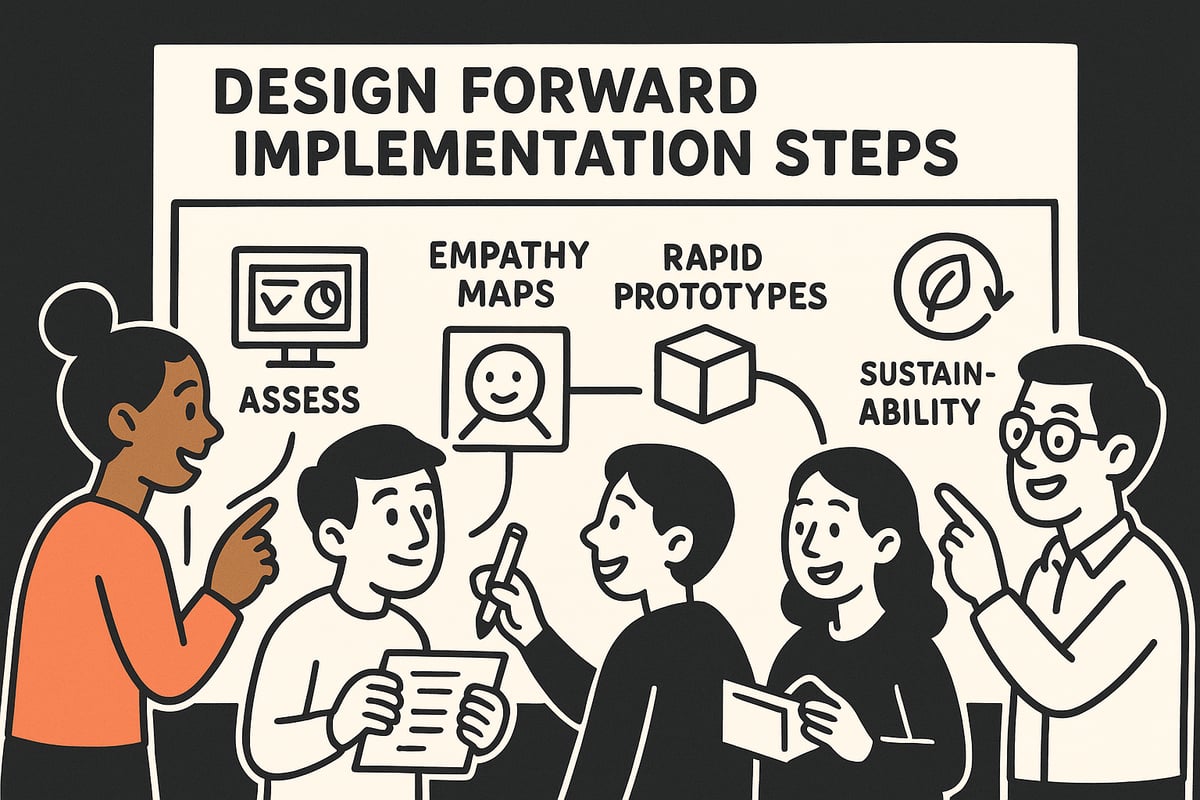
To embed a design forward approach in your organisation, a structured and practical roadmap is essential. This step-by-step guide breaks down the process into actionable stages, ensuring your business can adapt, innovate, and thrive in 2026. Each step is designed to maximise impact, foster collaboration, and ensure long-term value through design forward thinking.
Step 1: Assess Current Design Maturity
Begin by evaluating your existing design processes and organisational culture. A clear understanding of your starting point is crucial for a successful design forward journey.
Use maturity models and assessment tools to benchmark your current practices. Popular frameworks include the Design Maturity Scale and the NN/g DesignOps Audit. These tools help you identify strengths, gaps, and priority areas.
Key metrics to consider:
- Integration of design in decision-making
- Frequency of cross-team collaboration
- User feedback incorporation rate
Honest self-evaluation lays the groundwork for targeted improvements and ensures your design forward initiatives are built on solid foundations.
Step 2: Cultivate a Human-Centred Mindset
Transition from a product-centric to a user-centric approach. Design forward thinking places people at the heart of every decision, ensuring solutions resonate deeply with real user needs.
Leverage tools like empathy mapping, user journey mapping, and persona development. These methods help uncover pain points and motivations, guiding innovation.
Companies such as Airbnb and Monzo have excelled by prioritising empathy in every interaction. This human-centred focus strengthens loyalty, making design forward strategies a catalyst for meaningful customer relationships.
Step 3: Embed Design in Business Strategy
Aligning design goals with business objectives is fundamental for long-term success. Design forward thinking requires design to sit at the strategy table, not just in execution.
Establish cross-functional innovation teams that bring together design, product, marketing, and tech. Use strategic frameworks, like the Double Diamond or Business Model Canvas, to ensure design is woven into your planning processes.
Examples from global leaders like Apple show how integrating design forward principles into strategy consistently delivers market differentiation and sustainable growth.
Step 4: Foster Creative Experimentation and Rapid Prototyping
Encourage a culture of experimentation. Design forward organisations embrace rapid prototyping and iterative testing to explore ideas and validate concepts quickly.
Adopt tools such as Figma, InVision, or low-code platforms for swift prototyping. This approach accelerates feedback cycles and reduces time-to-market.
Breakthrough products, such as Dyson’s vacuum range, emerged from relentless prototyping. Creative experimentation is a hallmark of design forward teams, sparking innovation and minimising costly missteps.
Step 5: Leverage Technology and Data for Design Insights
Harness the power of AI, big data, and emerging technologies to inform your design forward decisions. Data-driven insights reveal user behaviour patterns and market trends, guiding innovation.
For instance, AI-powered analytics can uncover unmet needs, while IoT data can optimise product functionality. According to recent industry reports, organisations using AI in their design forward processes see faster iteration and improved outcomes.
Balance quantitative data with creative intuition to maintain originality and relevance in every design forward initiative.
Step 6: Prioritise Sustainability and Ethics in Design
Sustainability is now a non-negotiable aspect of design forward thinking. Apply principles like circular design, regenerative innovation, and ethical tech practices to future-proof your offerings.
Consider the full lifecycle of your products, from sourcing to disposal. Brands like Patagonia and IKEA have set benchmarks by embedding sustainability into their design forward strategies.
Ethical considerations, such as inclusivity and privacy, are equally vital. Consumer surveys consistently show a preference for brands embracing responsible and sustainable design forward approaches.
Step 7: Measure, Learn, and Iterate
Continuous improvement is essential for maintaining a competitive edge. Design forward organisations establish robust feedback loops to measure, learn, and iterate.
Track key performance indicators such as user satisfaction, time-to-market, and innovation ROI. Use dashboards to visualise progress and identify bottlenecks.
Iterative cycles, as seen at Spotify and Atlassian, foster a culture where failure is viewed as a learning opportunity. Regular reflection ensures your design forward investments deliver sustained value.
Overcoming Common Implementation Challenges
Adopting a design forward mindset is not without hurdles. Common barriers include resistance to change, siloed teams, and resource constraints.
To overcome these, start with leadership alignment and clear communication of the value of design forward thinking. Break down silos through cross-functional workshops and shared objectives.
Learning from organisations that have successfully navigated these challenges, such as through Clutch design tips and trends, can provide actionable insights. Overcoming these obstacles unlocks the full potential of design forward innovation, driving measurable business success.
Real-World Examples of Design Forward Innovation
The impact of design forward thinking is best illustrated by real-world examples. Leading organisations have embraced this approach, transforming markets and setting new benchmarks for innovation. By examining their stories, we can see how design forward strategies drive measurable change and inspire others to follow suit.
Apple: Pioneering Design Forward Innovation
Apple stands as a global example of design forward excellence. The company’s unwavering commitment to user-centric design is evident in products like the iPhone and Apple Watch. Each iteration focuses on simplicity, intuitive interfaces, and seamless integration with daily life. This design forward mindset has not only elevated product usability but also contributed to Apple’s sustained market leadership.
Apple’s leadership actively champions a culture where design and technology work hand in hand. The result is a strong brand identity and remarkable customer loyalty. Notably, after adopting design forward principles, Apple’s market share and profit margins outpaced competitors, reinforcing the tangible value of this approach.
frog design: Shaping Transformative Experiences
frog design has become synonymous with design forward transformation across industries. The agency’s portfolio includes breakthrough projects for brands such as Sony, GE, and Disney. frog design’s process blends human insight with emerging technologies, ensuring each solution is both innovative and relevant.
For example, frog design played a key role in developing the Sony Walkman’s visual identity, making it a cultural icon. Their collaborative, cross-disciplinary teams use rapid prototyping and user testing to validate ideas early. This design forward approach has enabled clients to launch products that resonate deeply with users, driving engagement and setting new industry standards.
Louis Vuitton: Luxury Redefined Through Design Forward Strategies
Louis Vuitton exemplifies how design forward thinking can redefine an entire sector. The luxury brand has embraced digital transformation, incorporating augmented reality and sustainable materials in its product lines. These innovations align with changing consumer values, blending heritage with modern relevance.
The company’s design forward commitment is also evident in its eco-conscious initiatives, such as upcycled collections and transparent supply chains. As a result, Louis Vuitton has seen increased brand engagement and attracted new, environmentally aware customers. Their design forward approach has secured industry awards for both innovation and sustainability.
Comparative Outcomes: Measuring Design Forward Impact
The measurable outcomes of design forward strategies are clear when comparing pre- and post-implementation performance. Consider the following table:
| Organisation | Key Project | Pre-Implementation | Post-Implementation |
|---|---|---|---|
| Apple | iPhone, Apple Watch | Moderate growth | Market leader, high loyalty |
| frog design | Sony Walkman, Disney apps | Industry average | Iconic products, awards |
| Louis Vuitton | Digital AR, upcycled lines | Traditional luxury | New markets, sustainability |
Each organisation’s design forward journey has resulted in improved user engagement, stronger market share, and recognition for design excellence.
Lessons, Recognition, and Industry Trends
Several lessons emerge from these design forward case studies. Leadership commitment, a culture of experimentation, and user-centric values are essential. These companies have also shown that sustained investment in design forward thinking leads to long-term competitive advantage and resilience.
Industry awards, such as the Red Dot and iF Design Awards, frequently acknowledge these efforts. As highlighted in the Design Trend Forecast 2026, the integration of AI and sustainability is set to accelerate the adoption of design forward principles. Organisations that embrace these trends position themselves at the forefront of innovation, ready to shape the future.
Key Trends Shaping Design Forward Thinking for 2026
The landscape of design forward innovation is rapidly evolving as 2026 approaches. Organisations are challenged to anticipate change and leverage emerging trends to remain competitive. Understanding these key trends is essential for any business intent on embedding design forward principles at the heart of their operations.
Macro Trends for 2026
Several macro trends are defining the direction of design forward thinking for 2026. Artificial intelligence is transforming how teams generate insights, automate repetitive tasks, and personalise user experiences. Digital transformation has accelerated, with businesses adopting cloud, mobile-first, and platform-based models to stay agile.
Sustainability is now non-negotiable. The circular economy is reshaping product lifecycles, encouraging brands to design for reuse and recycling from the outset. Hyper-personalisation, powered by data analytics and AI, allows companies to deliver highly tailored experiences.
For a detailed look at industry-specific applications, see Essential IT website design trends, which showcase how design forward strategies are reshaping digital interfaces and customer engagement.
The Rise of Remote Collaboration and Global Talent
Remote collaboration is another cornerstone of design forward innovation. With distributed teams becoming the norm, organisations are leveraging digital tools to foster creativity across continents. This shift enables companies to access a global talent pool, bringing together diverse perspectives that fuel breakthrough ideas.
Digital whiteboards, synchronous editing platforms, and virtual workshops are now indispensable. These tools not only enhance productivity but also support a more inclusive and flexible work environment, essential for any design forward organisation aiming to innovate at pace.
Inclusive, Accessible, and Ethical Design Standards
In 2026, inclusivity and accessibility are central to design forward approaches. Regulatory requirements and consumer expectations drive brands to prioritise accessible interfaces and ethical design choices. Designing for neurodiversity, physical abilities, and cultural contexts is no longer optional.
The focus on ethical design extends to privacy, data security, and transparency. Companies that integrate these principles build stronger trust and loyalty, positioning themselves as leaders in the design forward landscape.
Emerging Technologies and Market Outlook
Emerging technologies are redefining what is possible in design forward innovation. Augmented reality and virtual reality open up new ways to engage users and prototype products. The Internet of Things enables seamless integration between physical and digital worlds, enhancing user experiences.
Blockchain technology is being explored for secure transactions and transparent supply chains, supporting ethical and sustainable design forward initiatives. Market forecasts indicate robust growth, with the global design thinking market projected to expand significantly by 2026. For further insights, explore the Design Thinking Market Size and Growth Forecast, which details industry adoption rates and investment trends.
Businesses that harness these trends can future-proof their operations, cultivate resilience, and establish a clear competitive edge. Keeping pace with design forward advancements ensures not only survival but also sustained leadership in a rapidly shifting landscape.
Actionable Insights for Businesses and Teams
Adopting a design forward approach in 2026 is not just a trend, but a necessity for organisations seeking sustained innovation. The rapid evolution of technology, shifting consumer expectations, and the increasing demand for ethical solutions all point to the need for practical, business-ready strategies.
Practical Steps to Embed Design Forward Thinking
Organisations can start their design forward journey by following these core actions:
- Secure leadership commitment: Leaders must champion design forward thinking, set clear objectives, and allocate resources.
- Assess current maturity: Use assessment tools to evaluate existing design processes, culture, and team capabilities.
- Form cross-functional teams: Integrate design, technology, marketing, and business units to foster innovation.
- Prioritise user-centricity: Place the end-user at the heart of every decision, using empathy mapping and journey analysis.
- Promote creative experimentation: Encourage rapid prototyping and iterative testing to refine ideas quickly.
- Leverage data and technology: Utilise AI, analytics, and emerging tools for informed decision-making.
- Emphasise sustainability and ethics: Embed responsible practices in every stage of the design forward process.
Checklist: Building a Design Forward Team
| Step | Action Point | Example Outcome |
|---|---|---|
| Leadership Buy-In | Executive sponsorship and communication | Cultural alignment |
| Process Assessment | Use design maturity audits | Identified gaps |
| Skills Development | Upskilling in design thinking | Increased innovation rate |
| Cross-Disciplinary Teams | Blend diverse expertise | Broader ideation |
| Experimentation Culture | Implement prototyping sprints | Faster time-to-market |
| Sustainability Focus | Apply circular design principles | Reduced waste |
For a deeper dive into integrating design forward strategies into your branding and team workflows, explore the Digital branding solutions guide.
Training and Upskilling Opportunities
Continuous learning is vital for maintaining a design forward edge. Invest in training programmes that cover human-centred design, systems thinking, and digital innovation. Encourage participation in workshops, online courses, and industry certifications. This commitment to growth helps teams stay agile and future-ready.
Mentorship and peer learning can accelerate the adoption of design forward mindsets. Facilitate internal knowledge sharing, invite guest experts, and engage with wider innovation communities.
Measuring and Communicating Impact
To demonstrate the value of design forward initiatives, implement clear measurement frameworks. Track key performance indicators such as user satisfaction, innovation cycle time, and sustainability metrics. Use storytelling and data visualisation to communicate successes across the organisation.
Stay updated on new metrics and methodologies by following research, such as the Research Activities 2026 – Thinking Ahead Institute, which explores advanced models for measuring innovation and resilience.
Scaling Design Forward Thinking
Scaling design forward thinking requires both structure and flexibility. Standardise best practices across departments, while allowing for local adaptation. Use collaborative platforms to connect remote teams and share learnings.
Encourage experimentation at all levels, from startups piloting new ideas to enterprises evolving legacy systems. Recognise and celebrate small wins to build momentum and sustain engagement.
Resources, Toolkits, and Ongoing Support
Equip your teams with access to design forward resources, including toolkits, online communities, and industry networks. Regularly review and update your resource library to reflect the latest trends and technologies.
By embracing these insights, businesses and teams can confidently navigate the complexities of 2026 and unlock the full potential of design forward thinking.