
E Commerce Page Design Guide: Expert Insights for 2026
E-commerce is transforming at an unprecedented pace, with design emerging as the cornerstone of digital success in 2026. As online shopping evolves, brands face the challenge of not only attracting visitors but also converting them in an increasingly saturated marketplace.
Standing out demands more than just appealing visuals. Businesses must understand shifting consumer behaviours and adapt quickly. Innovative design strategies, guided by expert insights, can make the difference between thriving and being left behind.
This comprehensive guide to e commerce page design will equip you with the trends, actionable advice, and best practices needed to build conversion-focused, future-ready pages. We will explore key design principles, emerging trends, a step-by-step design process, UX/UI strategies, technology integration, and practical tips to future-proof your e-commerce presence.
Core Principles of E-Commerce Page Design in 2026
Creating a high-performing e commerce page design in 2026 demands a deep understanding of user needs, technology, and evolving industry standards. This section explores the foundational pillars that underpin successful e-commerce experiences, guiding brands to deliver value, trust, and seamless interactions.

Understanding User Intent and Behaviour
Modern e commerce page design starts with data-driven insights. By analysing user behaviour and intent, brands can shape experiences that feel intuitive and relevant. Advanced analytics tools help map customer journeys, revealing where users engage or drop off.
Personalisation based on browsing and purchasing patterns is becoming standard. For example, brands now use AI to predict what a customer might want next, streamlining the path to purchase. According to Salesforce (2023), 74% of consumers expect personalised experiences, making this principle crucial for conversion.
Visual Hierarchy and Brand Consistency
Effective e commerce page design organises content so users can quickly find what they need. Visual hierarchy uses layout, spacing, typography, and colour to guide attention to key actions.
Maintaining brand consistency across every page builds trust and recognition. Leading brands leverage cohesive visual systems, ensuring everything from buttons to banners aligns with their identity. Strategic use of whitespace and colour psychology further enhances readability and focus.
Mobile-First and Responsive Design
With 72% of e-commerce traffic now on mobile (Statista, 2024), e commerce page design must prioritise mobile-first experiences. Designing for touch, fast loading, and accessibility ensures no user is left behind.
Responsive layouts adapt content blocks for different devices, maintaining clarity and usability. Optimising mobile checkout is vital, as friction here can cause users to abandon their basket.
Fast Loading Times and Performance
Speed is a non-negotiable in e commerce page design. Slow pages drive users away, increasing bounce rates and reducing conversions. Optimising images, scripts, and server responses can dramatically improve performance.
Tools such as Google Lighthouse allow teams to measure and address bottlenecks. Prioritising performance ensures every visitor enjoys a smooth and efficient journey, regardless of their device or connection.
Accessibility and Inclusivity
Accessible e commerce page design opens doors to a wider audience. Following WCAG 2.2 guidelines, designers use high colour contrast, alt text, and keyboard navigation to support users with disabilities.
Legal standards are tightening, and inclusive design increases market reach. Brands that invest in accessibility not only avoid legal risks but also demonstrate social responsibility and care for all customers.
Trust Signals and Social Proof
Trust is the foundation of every e commerce page design. Visible reviews, trust badges, and secure payment icons reassure visitors they are in safe hands. These signals influence purchasing decisions and boost conversion rates.
Case studies show measurable improvement when trust elements are added. Displaying real customer feedback and security credentials helps turn visitors into loyal buyers.
Conversion-Focused CTAs and Messaging
Compelling calls-to-action are the heartbeat of effective e commerce page design. Button placement, colour, and copywriting all impact engagement. Leading brands test different CTA styles and messaging to discover what drives the best results.
A/B testing reveals which approaches convert at higher rates. For inspiration and expert strategies, see the E-Commerce Design & Development page, which details proven methods for high-converting e-commerce experiences.
Emerging Trends Shaping E-Commerce Page Design
The landscape of e commerce page design is evolving rapidly in 2026. Brands that stay ahead of the curve leverage new technologies and design philosophies to meet rising customer expectations. Understanding these trends will help you create pages that not only look modern but drive tangible results.

AI-Driven Personalisation
AI is transforming e commerce page design by enabling real-time personalisation for every visitor. Modern platforms analyse browsing and purchase behaviour, dynamically adjusting product recommendations and content. Predictive search helps customers find what they want faster, while tailored landing pages boost conversion rates.
According to Epsilon, 80% of shoppers are more likely to buy from brands offering personalised experiences. For a deeper look at how AI personalisation is shaping the future, see AI-Driven Personalization in E-Commerce. This shift is revolutionising how brands engage and convert users.
Immersive Visuals: AR, VR, and 3D Elements
Immersive visuals are elevating e commerce page design to new heights. Augmented reality (AR) and virtual reality (VR) let shoppers try on fashion or visualise furniture in their space, increasing confidence and reducing returns. 360° product views and interactive 3D models provide richer, more engaging experiences.
Leading fashion and home brands are at the forefront of this trend, integrating AR/VR seamlessly into their sites. These technologies are quickly becoming essential for brands seeking to stand out and offer memorable shopping journeys.
Voice Commerce and Conversational Interfaces
Voice commerce is emerging as a major force in e commerce page design. With 40% of UK households expected to use smart speakers for shopping by 2026, designing for voice search and conversational UI is no longer optional.
Optimised product discovery through voice commands and chatbot-driven support improves accessibility and convenience. Smart assistant integration helps users shop hands-free, creating a frictionless experience that appeals to a growing segment of digital shoppers.
Sustainable and Ethical Design
Sustainability is now a core consideration in e commerce page design. Brands are showcasing eco-friendly credentials and supply chain transparency directly in their interfaces. Minimalist layouts reduce digital carbon footprints, while clear messaging about ethical sourcing builds trust.
Consumers are increasingly seeking out brands that align with their values. By highlighting sustainability in the UI, businesses can attract conscious shoppers and foster long-term loyalty.
Micro-Interactions and Animation
Micro-interactions are shaping the next generation of e commerce page design. Subtle animations provide feedback for actions like adding items to a cart or saving favourites. These small touches enhance user engagement and communicate quality.
Effective use of animation can make a site feel more intuitive and delightful. Brands that incorporate these details stand out in a crowded marketplace, making every interaction feel meaningful.
Zero-Party Data Collection
Zero-party data is revolutionising how brands approach e commerce page design. Instead of relying solely on third-party cookies, brands now engage users directly through quizzes, surveys, and profile creation.
This approach balances privacy with personalisation, as 63% of consumers are willing to share data for personalised offers. It enables brands to build trust and deliver highly relevant shopping experiences.
Inclusive and Multicultural Design
Inclusivity is essential in modern e commerce page design. Brands are adapting visuals and content to resonate with diverse audiences worldwide. Multilingual support and region-specific UX ensure that everyone feels welcome.
International brands lead by tailoring layouts, imagery, and messaging for local relevance. This commitment to inclusivity expands market reach and strengthens brand reputation.
Step-by-Step Guide to Designing a High-Converting E-Commerce Page
Designing a high-converting e commerce page design requires a structured approach. Each step in this guide builds upon the last, ensuring your brand not only attracts visitors but also turns them into loyal customers. Let us walk through the process, highlighting best practices and actionable insights for 2026.
Step 1: Define Goals and Target Audience
Every successful e commerce page design starts with clear goals. Define what you want to achieve, whether that is increasing sales, generating leads, or boosting engagement. Outline specific business KPIs, such as conversion rate, average order value, or customer retention.
Develop detailed buyer personas by analysing demographics, interests, and shopping behaviours. Understanding your target audience ensures your e commerce page design is tailored to their needs and expectations.
For example, in the Muse E-Commerce Case Study, the brand transformed its results by aligning design decisions with audience insights, leading to measurable improvements in engagement and revenue.
Step 2: Map the Customer Journey
Mapping the customer journey is fundamental to effective e commerce page design. Identify every touchpoint, from landing page to checkout, and visualise how users interact with your site.
Use journey mapping tools to chart typical paths and pinpoint friction areas. Address pain points such as confusing navigation or slow loading times to reduce drop-offs.
Break the journey into stages:
- Awareness: First impressions, homepage clarity
- Consideration: Product pages, comparisons, reviews
- Decision: Cart, checkout, payment process
By understanding the journey, you can optimise each stage for seamless progression, increasing the likelihood of conversion.
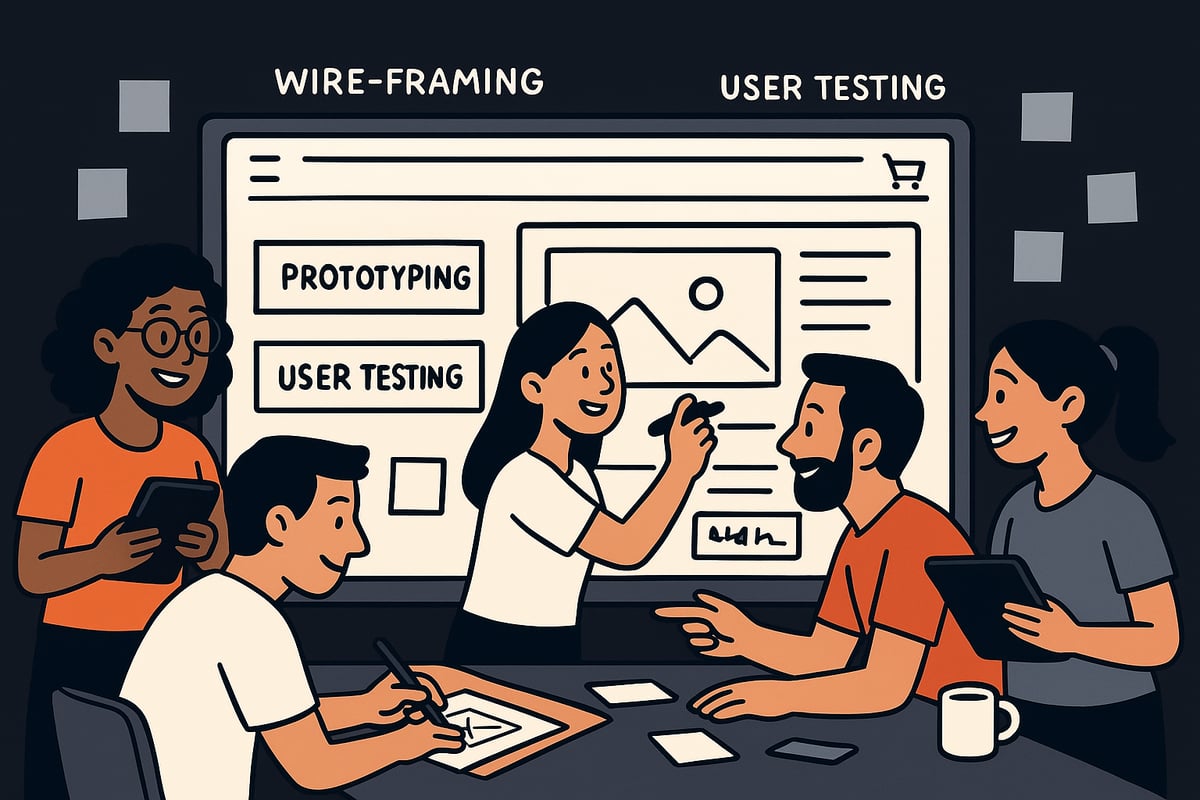
Step 3: Wireframing and Prototyping
Wireframing is where your e commerce page design takes shape. Sketch basic layouts that prioritise essential elements like CTAs, product images, and trust signals. Keep structures simple and intuitive.
Use prototyping tools such as Figma or Adobe XD to create interactive mock-ups. Rapid iteration allows you to test ideas and gather feedback quickly, refining your design based on real user responses.
Establish a feedback loop by conducting usability tests with a sample of your target audience. This ensures your e commerce page design resonates before full development begins.
Step 4: Crafting Compelling Visuals and Content
Visuals and content are at the heart of effective e commerce page design. Invest in high-quality product photography and engaging video to showcase your offerings.
Write persuasive copy for headlines, descriptions, and CTAs. Focus on clarity, benefits, and emotional triggers that resonate with your audience. Maintain a consistent brand tone across every touchpoint.
A well-crafted e commerce page design tells a story, guiding visitors through your value proposition and encouraging them to take action.
Step 5: Implementing UX/UI Best Practices
Intuitive UX/UI is non-negotiable for modern e commerce page design. Create clear navigation menus and logical product categorisation to help users find what they need quickly.
Use filters and sorting options to streamline product discovery. Ensure the cart and checkout process is simple, with minimal steps and transparent costs.
Responsive layouts and mobile optimisation are essential, given the dominance of mobile traffic. Prioritise speed, accessibility, and ease of use in every aspect of your e commerce page design.
Step 6: Integrating Trust Elements and Social Proof
Trust is a critical driver of conversions in e commerce page design. Display customer reviews, ratings, and testimonials prominently to build credibility.
Incorporate secure payment badges, privacy assurances, and clear return policies. These trust signals reassure visitors and address common concerns.
Brands that highlight trust elements often see significant conversion uplifts. For instance, after adding more reviews and security icons, many retailers report higher checkout completion rates.
Step 7: Testing, Launch, and Continuous Optimisation
Launching your e commerce page design is only the beginning. Employ A/B and multivariate testing to compare different layouts, messaging, and CTA styles.
Track analytics and heatmaps to monitor user behaviour and identify areas for improvement. Use real-time data to iterate your design, ensuring it stays effective as user preferences evolve.
Continuous optimisation is key. Regularly update your e commerce page design based on feedback, trends, and business goals to maintain high performance and conversion rates.
Advanced UX/UI Strategies for E-Commerce Success
Advanced UX/UI strategies are redefining how e commerce page design drives conversions and customer loyalty in 2026. Brands that prioritise innovation, accessibility, and seamless experiences will outperform competitors. This section explores the leading techniques shaping e commerce page design, offering practical insights for sustained online success.
Personalisation and Dynamic Content
Personalisation is a cornerstone of modern e commerce page design. Adaptive landing pages respond to user behaviour, tailoring content and offers in real time. AI-driven product recommendations increase average order value by presenting relevant items based on browsing history.
Brands that leverage personalisation report higher engagement and loyalty. For example, platforms using dynamic content see users spending more time on site and returning frequently. Incorporating these strategies into e commerce page design helps businesses stand out and deliver memorable shopping experiences.
Frictionless Navigation and Search
Efficient navigation is vital to e commerce page design. Mega menus, predictive search, and voice navigation streamline user journeys, helping visitors find products faster. Sticky navigation bars and breadcrumbs offer constant orientation, reducing frustration.
A poor navigation experience can drive users away. In 2026, leading brands are adopting minimalist, functional layouts that prioritise clarity and speed. For further insights into these trends, see Minimalist and Functional E-Commerce Design. Refined navigation is essential for maximising conversion rates.
Checkout Optimisation and Cart Recovery
Checkout remains a critical touchpoint in e commerce page design. One-page and express checkouts minimise friction, allowing users to complete their purchase quickly. Cart abandonment triggers, such as timely reminders or follow-up emails, help recover lost sales.
Retailers implementing streamlined checkouts have reduced abandonment by up to 30 percent. Testing different layouts and payment options is key to finding the optimal design. Prioritising a frictionless checkout process in e commerce page design directly boosts revenue and customer satisfaction.
Visual Storytelling and Brand Experience
Compelling visuals and brand storytelling are essential for connecting with customers. High-quality imagery, video, and interactive lookbooks immerse users in the brand’s world. Shoppable content and lifestyle photography create emotional resonance, increasing engagement.
Leading lifestyle brands use visual storytelling to differentiate their e commerce offerings. These strategies foster trust and brand loyalty, turning visitors into advocates. Consistency in visuals and messaging is critical for a cohesive online presence.
Accessibility and Ethical UX
Accessibility is now a non-negotiable aspect of e commerce page design. Designing for neurodiversity and varied abilities ensures that all users can interact with your site. Features such as clear colour contrast, keyboard navigation, and screen reader support are essential.
Ethical UX also involves transparent data collection and privacy-first design. Adhering to accessibility standards expands your market reach and protects your brand from legal risk. Ethical principles in e commerce page design drive trust and long-term loyalty.
Mobile-First Micro-Interactions
Mobile-first micro-interactions bring delight and clarity to e commerce page design. Tap, swipe, and gesture-based animations provide immediate feedback, making the user journey intuitive and enjoyable. These subtle cues guide users through actions like adding items to the cart or saving favourites.
Successful brands in fashion and retail have seen increased engagement by prioritising mobile micro-interactions. As smartphone shopping dominates, optimising e commerce page design for mobile is essential for capturing and retaining customers.
Harley Oliver: Award-Winning E-Commerce Design Solutions
Harley Oliver sets the standard for e commerce page design excellence. Their award-winning team delivers bespoke solutions that elevate online shopping experiences. With a proven record of measurable client success, Harley Oliver’s projects consistently achieve high conversion rates and customer satisfaction.

Their future-focused approach ensures scalability and adaptability as the digital landscape evolves. If your brand seeks to future-proof its e commerce page design, explore how Harley Oliver can help you achieve your goals in 2026 and beyond.
Integrating Technology: Tools and Platforms for 2026
Staying ahead in e commerce page design means selecting the right blend of technology, platforms, and integrations. The right tools not only streamline operations but also create seamless, engaging experiences for every customer. As we look towards 2026, the technology landscape continues to evolve, offering new opportunities for growth and innovation.
Choosing the Right E-Commerce Platform
Selecting a robust platform is the foundation of effective e commerce page design. Shopify, Magento, WooCommerce, and BigCommerce remain the leading options, each offering unique strengths. Scalability is crucial for growing brands, while security and flexibility ensure your site can adapt to changing demands.
Many businesses are now migrating to headless commerce solutions. This approach separates the frontend and backend, allowing for greater customisation and smoother integration with third-party tools. For brands aiming to future-proof their online presence, platform choice directly impacts performance, agility, and long-term success.
Leveraging AI and Automation Tools
AI-driven tools are transforming e commerce page design by streamlining everything from customer service to inventory management. Chatbots provide instant support, while automation handles repetitive tasks and predictive analytics enhance pricing strategies.
Retailers increasingly use AI for demand forecasting, ensuring the right products are always in stock. Voice assistants and conversational interfaces are also rising in importance, enhancing accessibility and convenience. For more on the future of voice in e-commerce, see Voice Commerce and Conversational Interfaces.
Analytics, Heatmaps, and User Feedback
Data is at the heart of modern e commerce page design. Tools like Google Analytics, Hotjar, and FullStory allow brands to track user behaviour, identify friction points, and optimise every page element. Heatmaps, in particular, reveal where users click, scroll, or drop off.
A recent study found that 68% of top e-commerce brands use heatmaps for UX optimisation. Collecting and analysing feedback leads to targeted improvements, ensuring your design decisions are always data-driven and customer-centric.
Payment Gateways and Security Integrations
A seamless checkout experience is vital for conversion rates. Supporting a range of payment options, including digital wallets and Buy Now Pay Later services, caters to diverse customer preferences. Integrating secure payment gateways ensures PCI compliance and protects sensitive customer data.
Regular security audits and up-to-date encryption build trust and reduce the risk of breaches. The impact of smooth, secure transactions on conversion should never be underestimated when planning your e commerce page design.
Integrating Marketing and Growth Tools
Integrating marketing tools directly with your e commerce page design is essential for sustained growth. Automated email marketing, retargeting, and CRM systems help nurture leads and encourage repeat purchases. Upselling and cross-selling features can be seamlessly woven into the user journey.
Brands that connect marketing automation with their e-commerce platforms see increased customer lifetime value and better retention. For actionable strategies on building a future-ready design, explore Expert Design Strategies for 2025 Success.
Preparing for Future Tech: Blockchain and Web3
The next wave of e commerce page design will include emerging technologies like blockchain and Web3. Blockchain enables secure transactions and transparent supply chains, building additional trust with users.
NFT integration and blockchain-based loyalty programmes are beginning to reshape the online shopping experience. By anticipating and preparing for these innovations, brands can stay ahead of the curve and offer customers novel, secure ways to engage and transact.
Future-Proofing Your E-Commerce Page Design
Adapting to the evolving digital landscape is essential for long-term success in e commerce page design. Businesses must remain agile, anticipate changes, and invest in strategies that keep their online presence competitive and resilient.
Continuous Learning and Trend Monitoring
Staying ahead in e commerce page design means actively monitoring industry trends and absorbing new knowledge. Regularly following top blogs, attending conferences, and reviewing competitor sites can provide valuable inspiration. According to Shopify Plus, 60% of leading brands update their designs every 18 to 24 months, highlighting the importance of ongoing evolution.
Competitor analysis is a practical way to benchmark performance and identify opportunities. For a deeper dive into progressive techniques, exploring resources like the Step-by-Step Web Development Guide can further enhance your team's approach.
Building for Scalability and Flexibility
A future-proof e commerce page design requires scalability to accommodate growth. Modular design systems and reusable component libraries allow brands to expand product lines or enter new markets with minimal friction.
Flexible frameworks make it easier to adapt to emerging technologies or customer expectations. Retailers that have adopted adaptable design principles can quickly launch new features, ensuring their e commerce page design remains relevant and effective.
Prioritising Security and Compliance
Trust is vital in e commerce page design, especially as privacy regulations evolve. Brands must stay updated with laws such as GDPR and CCPA, conducting regular security audits and penetration testing to safeguard customer data.
Maintaining compliance not only protects users but also enhances brand reputation. Secure checkout processes and transparent policies can increase confidence, ensuring your e commerce page design remains a reliable destination for online shoppers.
Embracing Sustainability and Social Responsibility
Modern consumers are increasingly conscious of sustainability and ethical practices. Integrating eco-friendly features into your e commerce page design, such as energy-efficient layouts and highlighting ethical sourcing, can attract socially responsible shoppers.
Brands that communicate their sustainable efforts through UI elements, like badges or dedicated pages, often build stronger customer loyalty. Minimising digital waste and energy usage is also a practical step towards a greener e commerce page design.
Investing in Team Skills and Collaboration
Continuous development of your team’s capabilities is crucial for innovative e commerce page design. Upskilling designers, developers, and marketers ensures everyone stays current with cutting-edge tools and trends.
Encourage cross-functional collaboration to break down silos and foster creative solutions. Teams that work closely together can rapidly prototype, test, and implement improvements, driving measurable results for e commerce page design projects.
Measuring Success and Iterating
Setting clear KPIs and tracking performance metrics is essential for refining e commerce page design over time. Utilise analytics and direct user feedback to pinpoint areas for improvement.
Establish feedback loops to support ongoing optimisation. Brands that embrace iterative design often achieve sustained growth, as they can adapt quickly to shifting consumer preferences and market demands.